
Bittensor Accounting: How to Track TAO, Subnets, Staking, and Rewards
Bittensor is creating a new kind of decentralized economy around artificial intelligence.
Instead of AI development being concentrated within a handful of companies, Bittensor allows independent participants to contribute intelligence, infrastructure, models, and other digital resources through a decentralized network. Participants compete and collaborate across specialized networks called subnets and can earn rewards for the value they provide.
For finance teams, however, participating in Bittensor creates a different challenge.
Activity that makes sense onchain does not always translate cleanly into accounting records.
TAO transfers, staking, subnet tokens, rewards, wallet activity, and valuations can quickly create thousands of records that must eventually be reconciled, classified, valued, and entered into the books.
Understanding how Bittensor works is therefore only part of the equation. Finance teams also need a reliable way to turn that activity into accounting-ready financial data.
What Is Bittensor?
Bittensor is a decentralized network designed to create markets for machine intelligence and other digital commodities.
The network's native asset is TAO. TAO plays a central role throughout the Bittensor ecosystem, including staking, incentives, and participation in the network.
Bittensor is divided into specialized networks known as subnets. Each subnet can focus on a particular type of digital commodity or service, creating individual markets within the larger Bittensor ecosystem.
Participants generally operate in several different roles.
Miners perform work or provide resources to a subnet.
Validators evaluate the output of miners and help determine how incentives are distributed.
Subnet owners create and operate individual subnets.
Stakers allocate capital within the network and participate in its economic system.
This structure creates a highly dynamic ecosystem. It also means organizations participating in Bittensor can generate considerably more complex financial activity than simply buying and holding TAO.
Dynamic TAO Changed the Bittensor Economy
One of the biggest changes to Bittensor was the introduction of Dynamic TAO.
Under Dynamic TAO, individual subnets have their own tokens, commonly referred to as Alpha tokens. Each subnet operates with reserves of TAO and its subnet-specific Alpha token.
The relationship between these reserves helps determine the value of the subnet token.
When TAO is staked into a subnet, the participant receives exposure to that subnet's Alpha token. The relative economic value of subnets can then influence how emissions are distributed throughout the Bittensor ecosystem.
In other words, a finance team may no longer be dealing with TAO alone.
Depending on how an organization participates in Bittensor, its records may include TAO balances, subnet-specific assets, staking positions, emissions, rewards, transfers, and other onchain activity.
That makes accurate classification increasingly important.
Why Is Bittensor Accounting Complicated?
A traditional digital asset transaction can be relatively straightforward.
An organization buys an asset. The transaction has a date, quantity, price, fee, and cost basis.
Bittensor can introduce significantly more context.
A single organization might control multiple wallets while participating across several subnets. TAO may move between addresses. Assets may be staked. Rewards may accumulate. Alpha positions can change. Miners and validators can generate additional activity.
The accounting team has to determine what each transaction represents rather than simply recording that an onchain event occurred.
Depending on an organization's activities, finance teams may need to account for:
- TAO acquisitions and dispositions
- TAO transfers between wallets
- Staking and unstaking activity
- Subnet-specific Alpha tokens
- Miner and validator rewards
- Network emissions
- Transaction fees
- Cost basis
- Fair market value
- Realized and unrealized gains or losses
The challenge becomes even larger when multiple wallets, entities, or accounting periods are involved.
Blockchain data provides a record of what happened onchain. It does not automatically provide the accounting context needed to close the books.
Tracking Bittensor Staking and Rewards
Staking is one area where that difference becomes especially important.
Within Bittensor, TAO can be staked to validators and subnets. Under Dynamic TAO, staking into a subnet involves the subnet's Alpha token and its underlying TAO reserves.
For accounting teams, simply seeing TAO leave a wallet does not necessarily provide enough information to classify the transaction correctly.
Was the asset transferred?
Was it staked?
Was another asset received?
Did the organization receive a reward?
What was the value of the relevant asset at the time of the transaction?
Those distinctions matter when creating an accurate financial record.
Rewards add another layer. Organizations participating as miners, validators, subnet operators, or stakers may generate onchain rewards that need to be identified, valued, and connected to the appropriate wallet or entity.
At scale, manually reconstructing that history using block explorers and spreadsheets becomes difficult to maintain.
Subnet Tokens Add Another Layer of Accounting Complexity
Dynamic TAO means finance teams also need visibility into individual subnet positions.
Each subnet's Alpha token has an exchange rate relative to TAO based on the relationship between the TAO and Alpha held in its reserves.
Those rates can change as staking, unstaking, and emissions alter the subnet economy.
This introduces an important data requirement for accounting.
It is not enough to know that a transaction involved a subnet token. Finance teams need reliable historical information surrounding the transaction so the activity can be valued and classified appropriately.
As the number of subnets and transactions increases, maintaining that information manually becomes increasingly difficult.
From Onchain Activity to Accounting-Ready Data
This is where Bittensor accounting becomes less of a blockchain problem and more of a financial data problem.
The blockchain contains the underlying activity.
The finance team needs that activity transformed into a consistent financial record.
That means connecting wallets, identifying transactions, applying classifications, determining valuations, calculating cost basis, reconciling balances, and maintaining documentation that can support the organization's financial reporting and audit processes.
A scalable Bittensor accounting workflow should give finance teams the ability to:
- Connect and organize Bittensor wallets.
- Capture relevant TAO and subnet activity.
- Classify transactions consistently.
- Apply appropriate historical pricing and valuations.
- Track cost basis and gains or losses.
- Reconcile calculated balances against onchain activity.
- Maintain a clear transaction history and audit trail.
- Move finalized financial data into the organization's general ledger.
Without that infrastructure, accounting teams can find themselves spending significant time rebuilding transaction histories every month.
Bittensor Accounting With Cryptoworth
Cryptoworth helps bridge the gap between Bittensor's onchain activity and the financial systems accounting teams use every day.
Finance teams can connect Bittensor activity to Cryptoworth and manage TAO transactions alongside the rest of their digital asset portfolio.
Cryptoworth supports Bittensor transaction tracking across subnets, including rewards, transfers, and staking-related activity. Teams can calculate cost basis, track unrealized gains and losses, categorize transactions, perform reconciliation checks, and create a more complete record of their Bittensor activity. As emission rewards are earned, Cryptoworth automatically syncs them into the ledger as synthetic transactions, creating a record of rewards as they accrue.
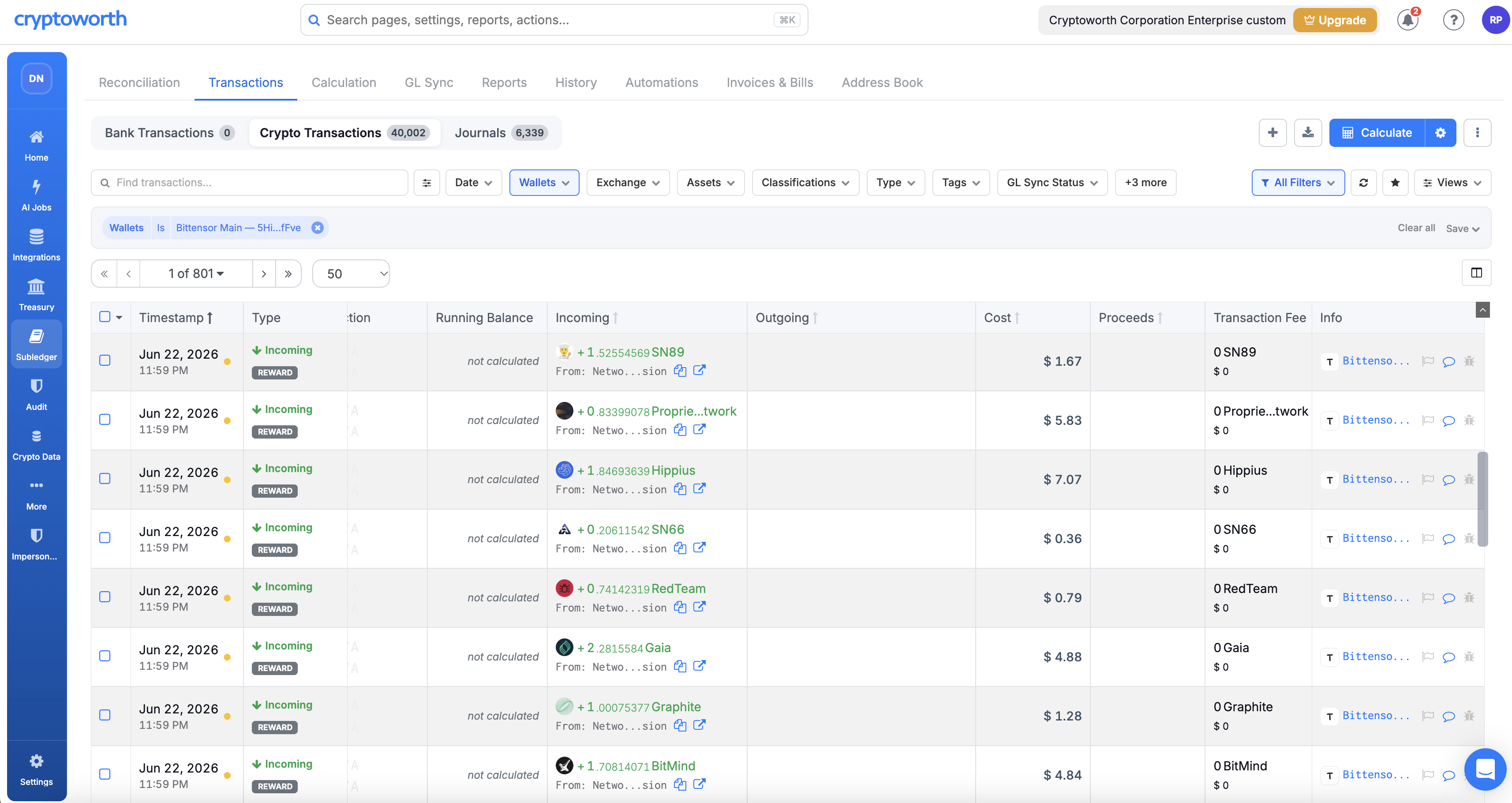
Instead of managing Bittensor separately from the rest of the organization's digital assets, finance teams can bring that activity into the same accounting workflow used across wallets, exchanges, and other blockchain networks.
Processed activity can then be incorporated into existing accounting workflows and systems, including platforms such as NetSuite and QuickBooks.
The result is more than a list of blockchain transactions.
It is financial data that accounting teams can actually work with.
Build an Audit-Ready Bittensor Accounting Process
Bittensor is pushing decentralized infrastructure into one of the fastest-moving areas of technology: artificial intelligence.
Its financial infrastructure is evolving just as quickly.
For organizations participating in the ecosystem, the challenge is making sure their accounting processes can keep pace.
TAO, subnet tokens, staking, rewards, and increasingly sophisticated onchain activity require more than a block explorer and a spreadsheet. Finance teams need complete transaction histories, consistent classifications, reliable valuations, reconciled balances, and documentation that can stand up to financial review.
Cryptoworth gives finance teams the infrastructure to turn complex Bittensor activity into organized, accounting-ready financial data.
Spend less time reconstructing Bittensor activity and more time closing the books with confidence.