Multi-entity accounting software, built for crypto finance teams
Cryptoworth is the crypto subledger that turns wallet-level data across every legal entity into a defensible consolidation package, behind whichever ERP your team already runs.
Built for controllers and CFOs at multi-entity crypto companies who are done stitching wallet CSVs into spreadsheets at month-end.


Your ERP can consolidate fiat. It cannot consolidate wallets.
Multiple legal entities. Dozens or hundreds of wallets. Intercompany token transfers between operating, treasury, and foundation entities. The accounting tool the rest of the business runs on was never built to ingest on-chain data per entity.Unlike fiat accounting, digital assets operate across multiple chains. Each chain has its own block explorer, data formatting, and rules for labeling transactions. There’s no enforced standard for categorization. Tokens can be wrapped, staked, re-staked, or accrue yield, behaving differently than traditional currencies.
Month-end stretches into multiple weeks. Audit prep becomes a forensic exercise. Intercompany balances surface as mismatches after consolidation, not before.This makes daily accounting tasks difficult to scale. You can’t rely on general-purpose software or spreadsheets when the data is inconsistent, nested, and constantly changing.
Built for the way multi-entity crypto companies actually close
Purpose-built features that streamline your digital asset bookkeeping and financial reporting.

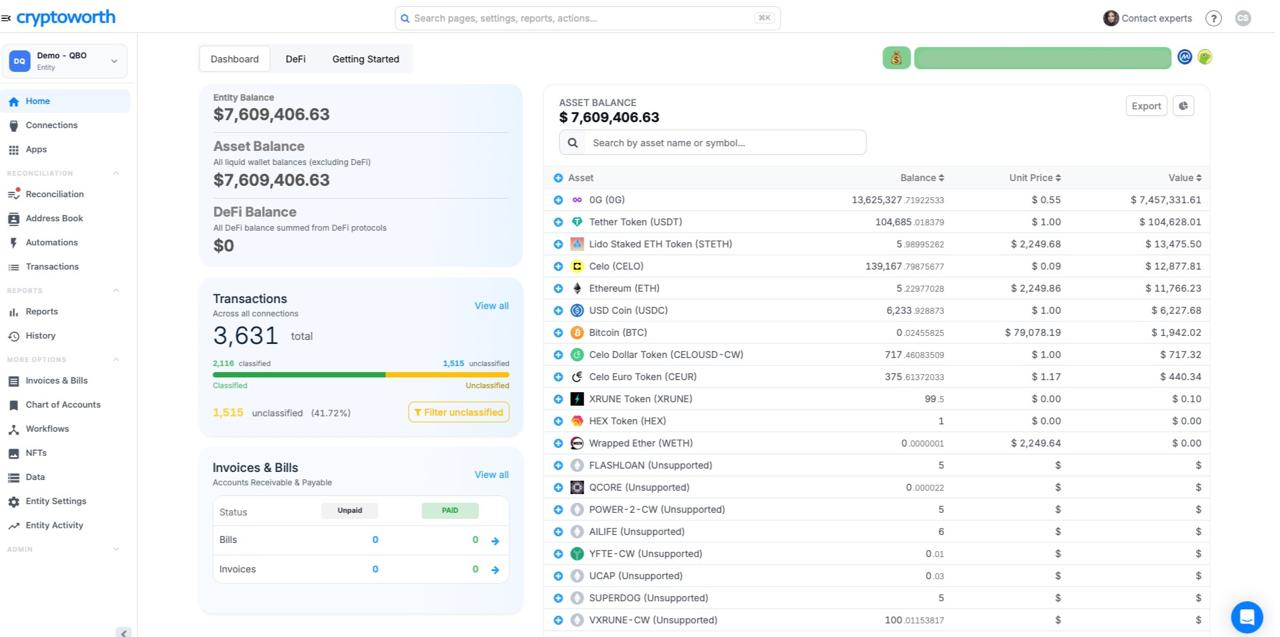
Wallet data ingested and segregated by legal entity
Every wallet, exchange account, and custodian gets mapped to the legal entity that owns it, at the data layer. Cryptoworth pulls activity directly from 230+ chains and 1,000+ data sources via public addresses or read-only API keys, with source-level entity tagging that holds when an auditor traces a transaction back to a subsidiary.
This is what auditors check first: not whether wallets are labeled in a tab, but whether they are demonstrably segregated in the system of record. That segregation is what turns a crypto accounting software overlay into a real subledger across the consolidated group.

Per-entity cost basis, fair value, and principal market settings
Cost basis methods (FIFO, LIFO, HIFO, WAC, specific identification) configure independently per entity. Fair value treatment under ASC 350-60 applies on a per-subsidiary basis, with ASU 2023-08 refresh logic that remeasures every reporting date, including interim periods, not just year-end.
Principal market settings under ASC 820 respect each subsidiary's actual venue access. Auditors will check whether principal market identification is consistent across the group and documented per entity. This is where group-wide assumptions tend to fall apart.

Intercompany reconciliation across subsidiary wallets
Intercompany token transfers between operating, treasury, and foundation entities get documented at the time of transaction, not reconstructed from block explorers at quarter-end. Per-entity cost basis tracking makes elimination entries mathematically supportable rather than directionally plausible.
ASC 810 requires intercompany income elimination unaffected by the existence of a noncontrolling interest, which is what reviewers test. The audit trail ties from wallet movement to journal posting without leaving the system.

Clean journal posting into NetSuite, QuickBooks, Xero, or Sage Intacct
Journals post into the GL with the correct subsidiary, department, class, location, and custom segment on each line. The chart of accounts hierarchy with parent and child relationships is respected on the way in, not flattened into a CSV that has to be unpacked downstream.
ERP-agnostic by design: NetSuite, QuickBooks, Xero, and Sage Intacct are all live integrations. For teams on QuickBooks or Xero, Cryptoworth acts as the consolidation layer those tools lack, journals post into the GL per entity while consolidation stays in Cryptoworth.
Why generic ERPs and spreadsheets break at the wallet layer
Each of these workflows can produce a consolidated output. None of them produce one that holds up at the wallet layer when auditors trace it back.
| Capability | Spreadsheet-based consolidation | Generic mid-market ERP |  |
|---|---|---|---|
| Wallet ingestion per entity | Manual CSV pulls, refreshed each close | Cannot ingest on-chain data | Direct ingestion with source-level entity mapping |
| Fair value at every reporting date | Manual rebuild every period | Manual rebuild every period | Automated per entity per period under ASC 350-60 |
| Intercompany elimination support | Reconstructed from explorers after the fact | Eliminations at the journal layer, no tie-back to wallet activity | Audit trail from wallet movement to journal entry |
| Audit defense | Trail lives in someone's laptop | No entity-level wallet segregation in the system | Trail stays in the system of record |
The structural problem: every additional entity, wallet, and reporting period multiplies the manual work. What is annoying at two entities and ten wallets becomes unauditable at six entities and two hundred wallets.

.avif)

.avif)
.avif)

.avif)
.avif)
.avif)
.avif)
.avif)


Trusted by enterprise crypto finance teams
SOC 1 and SOC 2 certified, with controls aligned to the close process and audit review cycle. Native integrations across NetSuite, QuickBooks, Xero, and Sage Intacct mean Cryptoworth fits whichever GL the team already runs. Coverage spans 230+ chains and 1,000+ data sources, so wallet activity gets ingested at the source rather than reconstructed from exports.
.avif)
.avif)
.avif)

.avif)
.avif)
.avif)
.avif)
.avif)
.avif)


.png)


Frequently asked questions
Still deciding? Here’s what accountants and financial controllers often ask.
Why doesn't QuickBooks work for multi-entity crypto accounting?
.png)
QuickBooks Online has no native multi-entity consolidation, no intercompany elimination, a capped chart of accounts, and two-decimal precision. Cryptoworth overlays QuickBooks as the crypto subledger so the GL stays in place while the multi-entity layer holds.
How does Cryptoworth handle intercompany token transfers between subsidiaries?
Per-entity wallet mapping captures intercompany movements at the time of transaction. Elimination entries tie back to wallet activity, supporting ASC 810's requirement that intercompany income be fully eliminated regardless of any noncontrolling interest.
Can Cryptoworth produce audit-ready consolidation packages across multiple entities?
Yes. Locked periods, pre-built sanity checks, full audit trail from wallet to journal, SOC 1 and SOC 2 controls, and entity-level cost basis evidence give reviewers what they actually request, not what's easy to export.
Which ERPs does Cryptoworth integrate with for multi-entity consolidation?
NetSuite, QuickBooks, Xero, and Sage Intacct. Subsidiary hierarchy, parent and child relationships, and chart of accounts mappings are respected on posting. Cryptoworth is ERP-agnostic, not tied to a single GL.
How does Cryptoworth keep principal market and fair value consistent across subsidiaries?
Principal market settings configure per entity under ASC 820. Fair value remeasurement applies at every reporting date under ASC 350-60, with documented assumptions per subsidiary that auditors can review across the consolidated group.
Can it generate digital asset tax reports?
You get days back from automated wallet ingestion, pre-built sanity checks, per-entity reconciliation before consolidation rather than after, and journal posting straight into the GL. Specific timing depends on entity count and wallet volume.
Ready to close your multi-entity books with confidence?
Cryptoworth gives multi-entity crypto finance teams a defensible consolidation across operating, treasury, and foundation entities, posted into the GL the rest of the business already runs. Audit-ready by design. Faster close. Fewer surprises at year-end.