The ERP-Integrated Treasury Platform Built for Crypto
Your TMS handles fiat treasury. It has no field for a DeFi swap, a multi-sig wallet balance, or a gas fee paid in ETH to execute a USDC transfer.
Cryptoworth is the crypto-native layer that sits alongside the ERP rather than replacing it, built for controllers who need reconciliation, fair value automation, and audit-ready treasury data to feed the close.
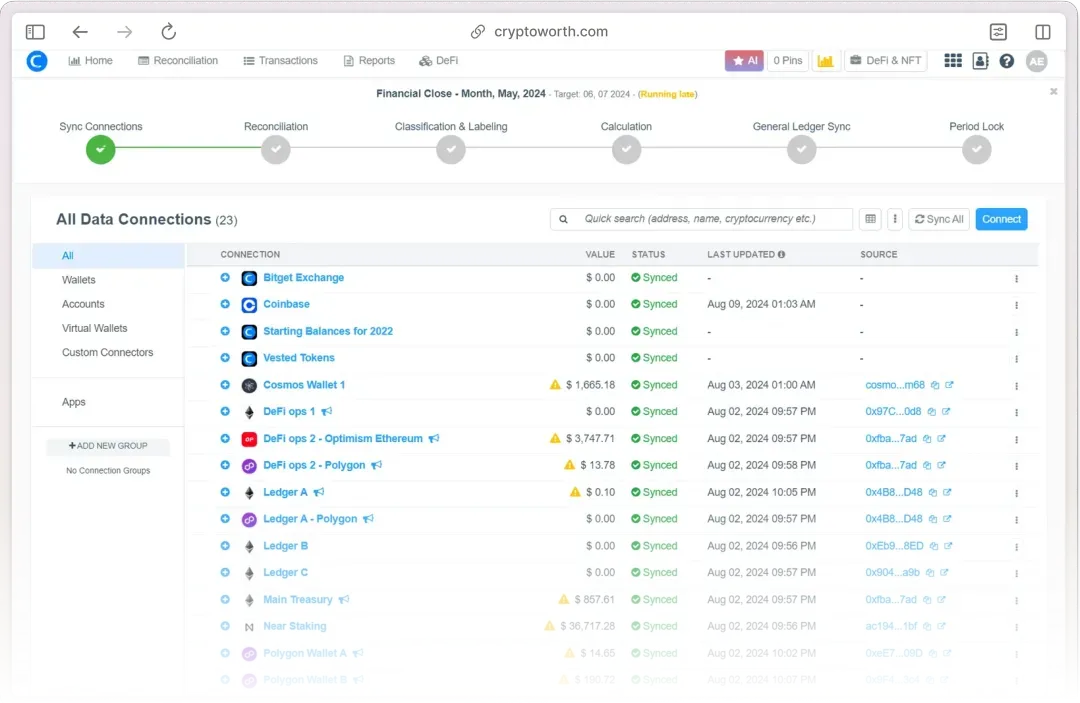
Why Enterprise Crypto Treasury Breaks at Month-End Close
Standard ERPs have no native fields for on-chain events: gas fees paid in ETH to execute stablecoin transfers, liquidity pool positions, smart contract interactions, or DeFi swaps that appear as three separate transactions in the custodian view. Finance teams build spreadsheet bridges to cover the gap, and those bridges break, typically around the third month-end close, when a team member leaves or transaction volume outpaces what can be reconciled manually.
Traditional treasury management systems do not solve this. They are built for fiat cash flows: bank connectivity, payment factories, FX risk management. They cannot reconcile on-chain wallet activity against the GL, automate fair value remeasurement under ASC 350-60, or produce the per-asset disclosure schedules that ASU 2023-08 now requires.
The result is unexplained P&L, close delays, and audit exposure on fair value support, custody documentation, and cost basis methodology. These are not edge cases. They are the predictable failure mode of bolting crypto onto a stack that was not built for it.
How Cryptoworth Integrates with Your ERP for Crypto Treasury

ERP-Native Subledger Architecture
The auditor will check whether your crypto positions agree to on-chain state, whether your journal entries are mapped to the correct chart-of-accounts codes, and whether your cost basis is documented at the lot level.
Cryptoworth is a purpose-built crypto accounting software that feeds clean, categorized journal entries directly into NetSuite, QuickBooks, Xero, or Sage Intacct without replacing the general ledger or the treasury management system. The ERP stays the system of record. Cryptoworth is the crypto layer that keeps it accurate.

Real-Time Crypto Bookkeeping & Reconciliation.
A single DeFi swap can appear as three separate events in the custodian view, with timing gaps between blockchain settlement and internal records. At scale, those discrepancies compound into unexplained write-offs and restatement risk.
Cryptoworth pulls transaction data from 200+ blockchains, major exchanges, custodians, and DeFi protocols into one reconciliation engine, resolves multi-event transactions into single clean GL entries, and flags discrepancies before they become audit findings.

ASU 2023-08 Fair Value Automation
Under ASC 350-60, your auditors will expect period-end fair value support for every in-scope position: remeasurement using the principal or most advantageous market, gains and losses presented separately on the income statement, and per-asset disclosures covering name, cost basis, fair value, and unit counts.
Without automated infrastructure, controllers rebuild that calculation manually every quarter. Cryptoworth automates the remeasurement workflow, sources principal market data defensibly, and generates the required disclosure schedules and gain/loss bridge ready for auditor review.

Multi-Custody and Self-Custody Control Documentation
Auditors expect demonstrated control of private keys, not just a balance report. Finance teams using self-custody or multi-custody arrangements need wallet-level governance documentation, signature verification records, and custody arrangement evidence that can survive personnel changes and Big 4 audit procedures.
Cryptoworth organizes that documentation inside the same platform that feeds the GL, so the custody control environment and the accounting record live in one place.
Real-Time Treasury Dashboards and Close Acceleration
Most crypto-holding finance teams enter month-end by pulling raw exports and rebuilding a cash position spreadsheet from scratch. Cryptoworth replaces that with real-time treasury dashboards showing positions across chains, wallets, custodians, and DeFi protocols, with period locks, sanity checks, and exportable audit-ready reports that feed the close rather than running in parallel to it.
Auditors expect demonstrated control of private keys, not just a balance report. Finance teams using self-custody or multi-custody arrangements need wallet-level governance documentation, signature verification records, and custody arrangement evidence that can survive personnel changes and Big 4 audit procedures.
See how Cryptoworth integrates with your ERP!
Why a Traditional TMS Is Not Enough for Crypto Treasury
Traditional TMS vendors are building digital asset capabilities onto fiat-first platforms. Custody platforms are absorbing reconciliation as a feature. Both approaches leave gaps that matter at close and under audit.
| Capability | Traditional TMS |

|
|---|---|---|
| On-chain reconciliation | Not supported | 200+ blockchains, exchanges, custodians, DeFi |
| ASU 2023-08 fair value automation | Not supported | Automated, principal-market-sourced, audit-ready |
| Multi-chain and DeFi coverage | Not supported | Native |
| Self-custody control documentation | Not supported | Wallet-level governance, signature verification |
| ERP subledger integration | Fiat GL only | NetSuite, QuickBooks, Xero, Sage Intacct |
| Per-asset audit disclosures | Not applicable | Generated automatically each period |
A corporate treasury running both fiat and crypto positions does not need to replace its TMS. It needs a crypto-native layer that covers what the TMS cannot, integrates into the same GL, and produces the audit documentation that closing and compliance require. That is the gap Cryptoworth fills.
Built for Audit-Grade Treasury Operations
Cryptoworth holds SOC 1 Type 1, SOC 2 Type 1, and SOC 2 Type 2 certifications.
ERP integrations are native, covering NetSuite, QuickBooks, Xero, and Sage Intacct. Blockchain coverage spans 200+ chains and 80+ exchanges, with direct integrations across major custodians and DeFi protocols.
The platform is built for the controls environment that Big 4 audit teams expect: role-based access, immutable audit trails, period locks, and segregation of duties across accounting functions.


Customer Stories
Accounting teams, funds, Layer 1s, L2s, and digital asset businesses trust Cryptoworth to deliver reliable, audit-ready reporting. No matter how complex their operations. Here’s what leaders say:

"As a frequent user of Cryptoworth, I can confidently say it's a game-changer in the world of cryptocurrency accounting. Handling high transaction volumes is a breeze, and the reports it generates are exactly what I need. The Cryptoworth team is incredibly responsive and always quick to address any issues, showcasing their dedication to user satisfaction.

Nauman Mustafa
CEO at Celo

"On the crypto accounting subledger tooling side, we had certain blockchain native complexities to work through on the accounting side. Internally, we’ve been happily working alongside Cryptoworth who have provided a very flexible product to fit our needs and help solve these complexities for us."

Zac Hogg
Controller at Solana Foundation

"Cryptoworth's UI is very user friendly and the implementation /integration of Stacks Blockchain within a week tells everything about the techinical capabilities of the team. The Customer Support provided by Geeth and Richard has been exemplary and one of the biggest reasons why we're a big supporter of Cryptoworth and promoting it across our Ecosystem!"

Shakti Pradhan
CFO at Stacks
"As a frequent user of Cryptoworth, I can confidently say it's a game-changer in the world of cryptocurrency accounting. Handling high transaction volumes is a breeze, and the reports it generates are exactly what I need. The Cryptoworth team is incredibly responsive and always quick to address any issues, showcasing their dedication to user satisfaction.
Nauman Mustafa
CEO at Celo
"On the crypto accounting subledger tooling side, we had certain blockchain native complexities to work through on the accounting side. Internally, we’ve been happily working alongside Cryptoworth who have provided a very flexible product to fit our needs and help solve these complexities for us."
Zac Hogg
Controller at Solana Foundation
"Cryptoworth's UI is very user friendly and the implementation /integration of Stacks Blockchain within a week tells everything about the techinical capabilities of the team. The Customer Support provided by Geeth and Richard has been exemplary and one of the biggest reasons why we're a big supporter of Cryptoworth and promoting it across our Ecosystem!"
Shakti Pradhan
CFO at Stacks
Frequently Asked Questions
Still deciding? Here’s what accountants and financial controllers often ask.
What is crypto treasury management for enterprise companies?
.png)
Crypto treasury management, for an enterprise controller, is a back-office accounting function, not a trading or portfolio management function. It means maintaining real-time position visibility across chains, wallets, custodians, and DeFi protocols, reconciling that activity to the GL each period, and producing the fair value support and disclosure data the auditor requires. It sits inside the close workflow, not outside it.
How does Cryptoworth integrate with NetSuite, QuickBooks, and other ERPs?
Cryptoworth functions as a crypto subledger: it maps on-chain transactions to chart-of-accounts codes, applies the correct cost basis method and fair value treatment, and pushes clean journal entries to the GL through native integrations with NetSuite, QuickBooks, Xero, and Sage Intacct. The ERP stays the system of record. Cryptoworth is the layer that keeps the crypto positions accurate and reconciled.
How does Cryptoworth handle ASU 2023-08 fair value requirements?
Cryptoworth automates the full remeasurement workflow required under ASC 350-60: period-end fair value calculation using defensible principal market sourcing, separate presentation of gains and losses, and per-asset disclosures covering name, cost basis, fair value, and unit counts. The documentation your auditors will request at close is generated automatically, not rebuilt from a spreadsheet each quarter.
Can Cryptoworth replace a traditional treasury management system?
No, and it does not need to. Cryptoworth is the crypto-native layer that sits alongside the existing TMS. The TMS manages fiat cash flows, bank connectivity, and payment operations. Cryptoworth handles the on-chain positions the TMS cannot reconcile. The two systems are complementary.
What is the difference between a TMS and a crypto subledger?
A treasury management system handles cash forecasting, payments, and fiat position management. A crypto subledger ingests on-chain activity, reconciles it to the GL, handles cost basis and fair value, and produces the audit-ready documentation that closing and compliance require. Cryptoworth is the latter, purpose-built for the accounting requirements a general-purpose TMS was never designed to meet.
Which blockchains and protocols does Cryptoworth support?
Cryptoworth supports 200+ blockchains, major exchanges and custodians, and 80+ DeFi protocols. If a position is on-chain, Cryptoworth can ingest it, reconcile it to the GL, and include it in the close and audit documentation.
Ready to Close Faster on Crypto Positions?
Controllers who need their crypto treasury data to hold up at close and under audit need infrastructure built for that job. A fiat TMS with a digital asset module is not that infrastructure. Cryptoworth is. Book a demo to see how it integrates with your existing ERP stack.